
1. Introduction
Few medical interventions have saved as many lives as vaccination, and few are judged so harshly when something appears to go wrong. Public fears about vaccines are disproportionately neurological and psychiatric. Images of paralysed limbs, convulsing adolescents, chronic pain, autism and unexplained collapse in schoolgirls are far more persuasive than statistics on prevented disease, and they have been used repeatedly to question immunization programmes. Neurologists and psychiatrists are therefore not bystanders in vaccine safety: they diagnose the events that frighten the public, and the way they interpret and communicate them can either sustain or undermine trust.
Human papillomavirus (HPV) vaccination illustrates this problem more clearly than any other programme. It is given to adolescent girls, often in schools, at an age when syncope, anxiety and functional neurological symptoms are common and when chronic conditions begin to appear by chance. In Kenya, HPV vaccination was introduced into routine immunization in 2019 and, following World Health Organization recommendations, the country moved to a single-dose schedule in November 2025, supported in part by the Kenyan KEN SHE trial, which showed vaccine efficacy of about 98% against persistent HPV 16/18 infection three years after a single dose.1 Coverage nevertheless remains low, and qualitative studies from Kenya document fears that the vaccine causes infertility, paralysis or unexplained illness.2 Experience from seven countries shows that HPV vaccine safety scares, often imported from abroad and amplified by media and politicians, can cause coverage to collapse for years.3
This viewpoint summarises current evidence on the neurological and psychiatric safety of vaccines, considers which signals have proved real and which have not, and discusses what this means for clinicians and for single-dose HPV vaccination in Kenya and similar settings.
2. How vaccine safety signals are detected and judged
Vaccine safety relies on several layers of evidence. Pre-licensure trials, even large ones, can detect only adverse events that occur more often than about 1 in 10,000. Rarer events are identified after licensure through passive reporting systems, such as the United States Vaccine Adverse Event Reporting System (VAERS), and confirmed or refuted through active surveillance, linked health databases and controlled epidemiological studies. Passive systems are sensitive but indiscriminate: anyone may report any event, and a report establishes neither causation nor frequency. An analysis of almost 78,000 VAERS reports after HPV vaccination between 2006 and 2024 illustrates both their value and their limits. Syncope, loss of consciousness, pallor and falls were the most frequently reported events, and postural orthostatic tachycardia syndrome (POTS) showed the strongest disproportionality signal, based on 680 reports, yet the authors emphasised that such signals reflect reporting patterns and require confirmation in controlled studies.4
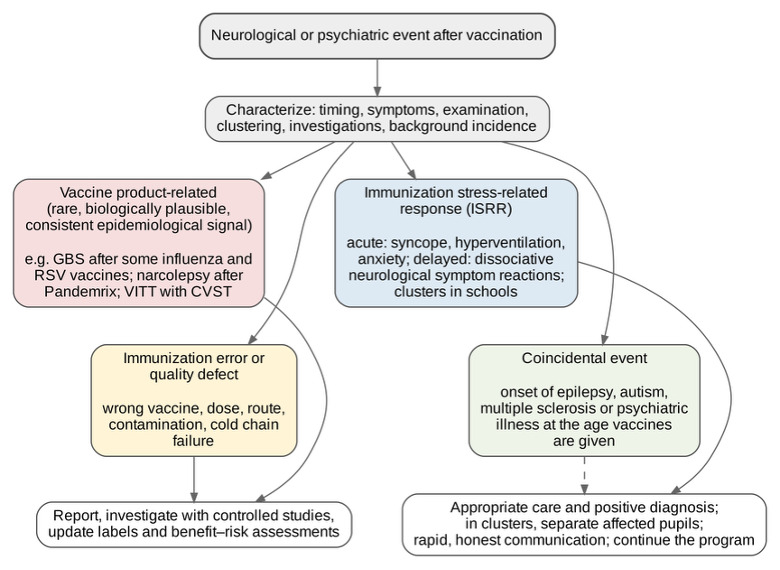
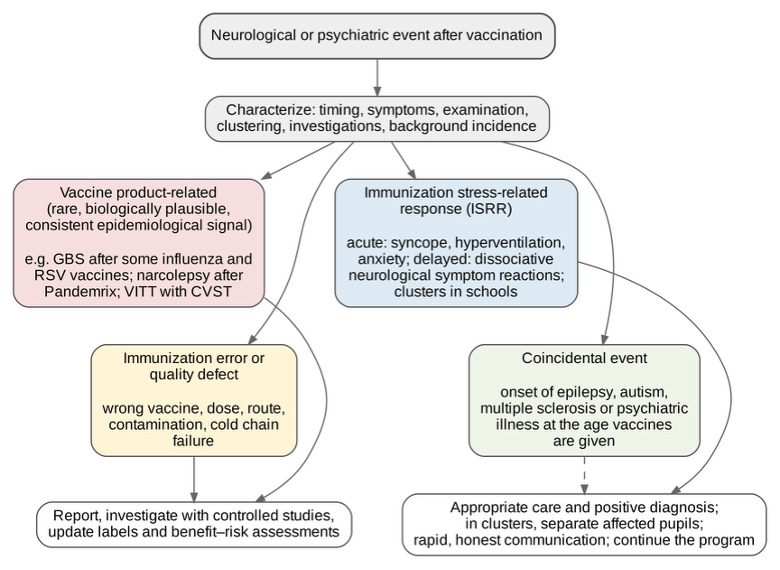
The decisive questions are whether an event occurs more often in vaccinated than in comparable unvaccinated people, whether it clusters in a biologically plausible time window, and whether the association is consistent across populations and study designs. Background incidence matters greatly. Epilepsy, autism, multiple sclerosis, depression and functional disorders all have their onset in childhood and adolescence, when most vaccines are given, so some will inevitably begin shortly after vaccination by chance. The safety record of the newest platforms has been reviewed in the same framework: after billions of doses, a recent review concluded that mRNA vaccines have a favourable safety profile, while emphasising the importance of continued post-licensure monitoring.5 Figure 1 summarises a pragmatic approach to classifying a neurological or psychiatric event after vaccination.
3. Neurological signals that proved real
The credibility of vaccine safety science rests on the fact that it does find real problems. Three examples are instructive for neurologists.
The first is narcolepsy after the AS03-adjuvanted pandemic influenza vaccine Pandemrix, used in Europe in 2009–2010. A systematic review and meta-analysis found a several-fold increase in narcolepsy in children and adolescents in the year after vaccination, with a smaller increase in adults, while the risk was not observed with other pandemic vaccines.6 The mechanism appears to involve molecular mimicry between viral nucleoprotein and hypocretin-related antigens in genetically susceptible individuals. The episode shows that rare autoimmune neurological complications can be detected, that they may be specific to a particular product rather than to vaccination in general, and that the signal was identified by clinicians who noticed an unusual cluster.
The second is Guillain–Barré syndrome (GBS). A small excess risk, of the order of one to two additional cases per million doses, has been recognised after some seasonal influenza vaccines for decades. More recently, an excess risk has been confirmed after respiratory syncytial virus (RSV) vaccination in older adults. In England, a self-controlled case series among adults aged 75–79 years found a relative incidence of 3.34 in the six weeks after bivalent RSV prefusion F vaccination, corresponding to about 23 additional cases per million doses, a risk the authors judged to be outweighed by the benefits of vaccination.7
The third is vaccine-induced immune thrombotic thrombocytopenia (VITT) after adenoviral-vector COVID-19 vaccines, which presented predominantly as cerebral venous sinus thrombosis with thrombocytopenia and antibodies against platelet factor 4.8 A multinational Global Vaccine Data Network study of 99 million vaccinated individuals subsequently confirmed higher than expected rates of GBS and cerebral venous sinus thrombosis after the ChAdOx1 vaccine and of acute disseminated encephalomyelitis after an mRNA vaccine, all very rare.9 In each case, the signal led to changes in product labels, age recommendations or vaccine choice, which is precisely how a functioning safety system should work.
4. HPV vaccines: neurological claims and the evidence
Since its introduction in 2006, HPV vaccination has been linked in the media and on social networks to a long list of neurological conditions, including GBS, multiple sclerosis, epilepsy, chronic fatigue, complex regional pain syndrome (CRPS) and POTS. These claims have been tested more rigorously than for almost any other vaccine.
In a Scandinavian cohort of almost one million girls aged 10–17 years, quadrivalent HPV vaccination was not associated with neurological outcomes, including epilepsy and paralysis, or with most autoimmune outcomes.10 A Danish and Swedish study of nearly four million women found no increase in the risk of multiple sclerosis or other demyelinating diseases.11 A systematic review and meta-analysis of studies published between 2000 and 2020 found no significant increase in the risk of GBS after HPV vaccination.12 In 2026, a propensity-matched cohort study using a large United States database, with more than 715,000 vaccinated and 715,000 matched unvaccinated individuals, found no increased hazard of CRPS, POTS, polyneuropathy, dysautonomia, GBS, encephalitis, myelitis, optic neuritis, Bell’s palsy, epilepsy or narcolepsy after HPV vaccination.13
Japan offers a sobering illustration of what happens when such claims drive policy. After media reports of chronic pain and movement disorders in vaccinated girls, the government suspended its proactive recommendation of HPV vaccination in 2013 and did not restore it until 2022, during which time coverage collapsed.3 The suspension was never supported by evidence of harm, and Japan has since built active, claims-based safety monitoring for all three HPV vaccine formulations within its VENUS network.14 The cohorts of Japanese girls who missed vaccination during those nine years will carry the cost in avoidable cervical cancer for decades.
5. Immunization stress-related responses: the real neuropsychiatric face of HPV vaccination
If HPV vaccines do not cause the neurological diseases attributed to them, what explains the dramatic episodes that have fuelled scares? The answer lies in immunization stress-related responses (ISRR), a term adopted by the WHO to replace the earlier “immunization anxiety-related reaction”.15 ISRR describes a spectrum of responses to the anticipation and act of vaccination rather than to the vaccine product. Acute responses include vasovagal syncope, hyperventilation with paraesthesia and carpopedal spasm, dizziness, palpitations and anxiety. Delayed responses include dissociative neurological symptom reactions, such as functional weakness, abnormal movements, non-epileptic seizures and altered speech, which are, in contemporary terminology, functional neurological disorder triggered by the vaccination context.15
Adolescents, girls, school settings, needle fear, crowding, witnessing others faint and media attention all increase the risk, and symptoms can spread rapidly through a group. In Carmen de Bolívar, Colombia, in 2014, a cluster of schoolgirls with fainting, headache and paraesthesia after HPV vaccination was widely broadcast; more than 600 cases were subsequently reported nationally, investigations found no organic cause, and first-dose coverage fell from 98% to 14%.16 In Bangladesh in October 2024, 19 of 80 vaccinated pupils in one school developed dyspnoea, cramps and body aches within hours of HPV vaccination; three had hypokalaemia due to hyperventilation, all recovered within 24 hours, and the event was classified as mass psychogenic illness after vaccine quality, cold chain and environmental causes had been excluded.17
These reactions are genuine experiences, not malingering, and they can be disabling. They are also not unique to HPV vaccines. A prospective study from an Italian tertiary centre found that functional neurological disorders were more frequent among patients hospitalised within 30 days of COVID-19 vaccination than among unvaccinated inpatients,18 underlining that the vaccination context itself can act as a trigger. For the clinician, the essential skills are the same as for any functional neurological disorder: a careful examination that demonstrates positive signs, such as Hoover’s sign or the variability and distractibility of tremor, an explanation that names the condition rather than merely excluding disease, and early rehabilitation. Telling a frightened adolescent and her family that “nothing is wrong” is both inaccurate and counterproductive.
6. Autism, development and other psychiatric claims
The longest-running vaccine controversy is psychiatric. The claim that measles, mumps and rubella (MMR) vaccine causes autism, based on a fraudulent and retracted 1998 report, has been refuted repeatedly. In a Danish cohort of more than 650,000 children, MMR vaccination was not associated with autism, including in children with a sibling history of autism or other risk factors.19 Attention has since shifted to aluminium adjuvants; a Danish nationwide cohort of more than 1.2 million children found no increase in the risk of autism, attention-deficit/hyperactivity disorder or 48 other chronic conditions with increasing cumulative exposure to aluminium-adsorbed vaccines.20 These studies are relevant to HPV vaccines, which also contain aluminium adjuvants, and to the broader climate of vaccine scepticism to which families in every country are now exposed through social media.
7. Implications for single-dose HPV vaccination in Kenya
Kenya’s move to a single-dose schedule is an opportunity to vaccinate more girls with the same resources.1 It also changes the dynamics of safety communication. With one dose, there is only one encounter in which to build trust, and an ISRR cluster during a school campaign could undermine coverage before a second contact is possible. Qualitative work in Kisumu County has shown that girls and parents fear infertility and paralysis, that knowledge of the vaccine is limited, and that fear of injections and poor communication are important barriers.2 These are exactly the conditions in which stress-related responses are likely and in which they will be interpreted as vaccine injury.
We suggest five practical measures. First, school-based campaigns should be organised to reduce stress: vaccination in a private space rather than in front of classmates, seating during and for 15 minutes after injection, avoidance of long queues, and simple explanations before the day. Second, health workers should be trained to recognise and manage syncope, hyperventilation and dissociative reactions, and to separate affected pupils quietly from others. Third, every county should have a rapid-response plan that includes clinical assessment, laboratory exclusion of organic causes and timely, honest public communication, because delay and silence allow rumours to set the narrative.3,17 Fourth, adverse event surveillance should be strengthened so that genuine signals can be distinguished from coincidental events and stress-related clusters. Finally, local neurologists, paediatricians and psychiatrists should be involved in investigating serious events and in explaining functional and stress-related conditions to families, journalists and religious and community leaders. Their clinical authority is often more persuasive than official statements.
8. Conclusions
The evidence on the neurological and psychiatric safety of vaccines is reassuring but not complacent. Surveillance systems have detected and acted upon real but rare risks, such as narcolepsy after Pandemrix, GBS after some influenza and RSV vaccines and VITT after adenoviral-vector COVID-19 vaccines. For HPV vaccines, two decades of research involving many millions of recipients show no increase in GBS, demyelinating disease, CRPS, POTS or other neurological disorders. The neuropsychiatric events that genuinely follow HPV vaccination are mostly immunization stress-related responses, which are predictable, manageable and, when mishandled, capable of damaging programmes for years. Neurologists and psychiatrists can contribute by recognising these responses, explaining them without dismissing patients, and helping countries such as Kenya make single-dose HPV vaccination both safe and trusted.
Conflict of interest statement
The author declares no conflict of interest.
Funding statement
This work received no specific grant or funding from any public, commercial or not-for-profit funding agency.