
1. Introduction
Anaemia is the most common haematological problem in low- and middle-income countries (LMICs), and in sub-Saharan Africa two causes stand out among children: sickle cell anaemia (SCA) and Plasmodium falciparum malaria. Both are diseases of the red cell, both are concentrated in the same tropical belt, and both injure the brain at the age when it is most vulnerable. Yet they are usually discussed separately, by haematologists on the one hand and infectious disease specialists on the other. For the neurologist and paediatrician working in an LMIC, the distinction is often artificial: the same child may live with SCA, contract malaria several times a year and present in coma, with seizures or with hemiparesis, and the long-term cost is paid in lost cognition, schooling and productivity.
The scale of both problems is considerable. The Global Burden of Disease study estimated that about 7.7 million people were living with sickle cell disease in 2021 and that some 515,000 babies were born with the condition that year, three-quarters of them in sub-Saharan Africa; total deaths attributable to sickle cell disease were about eleven times higher than those recorded under the disease itself as the underlying cause.1 The Lancet Haematology Commission concluded that, without newborn screening and basic preventive care, between half and nine-tenths of affected African children die before the age of five.2 For malaria, the World Health Organization’s World malaria report 2025 estimated 282 million cases and 610,000 deaths in 2024, the great majority in the African Region and in children under five, and reported confirmed or suspected partial artemisinin resistance in at least eight African countries.
The two conditions are also linked by evolution. The sickle haemoglobin allele reached high frequencies in Africa because heterozygous carriers (sickle trait) are strongly protected against severe malaria, a protection that, as recent genomic work has shown, depends in part on the genotype of the parasite.3 Children who inherit two sickle alleles, however, do not share this advantage in any simple way: malaria remains a major trigger of severe anaemia and death in SCA.4
This narrative review summarises current knowledge of the neurological complications of SCA and of malaria-related anaemia, with an emphasis on mechanisms they share, the evidence from trials conducted in Africa, and interventions that are realistic for LMIC health systems. We searched the literature up to June 2026, giving priority to randomised trials, large cohorts, systematic reviews and international guidelines.
2. Shared mechanisms of brain injury
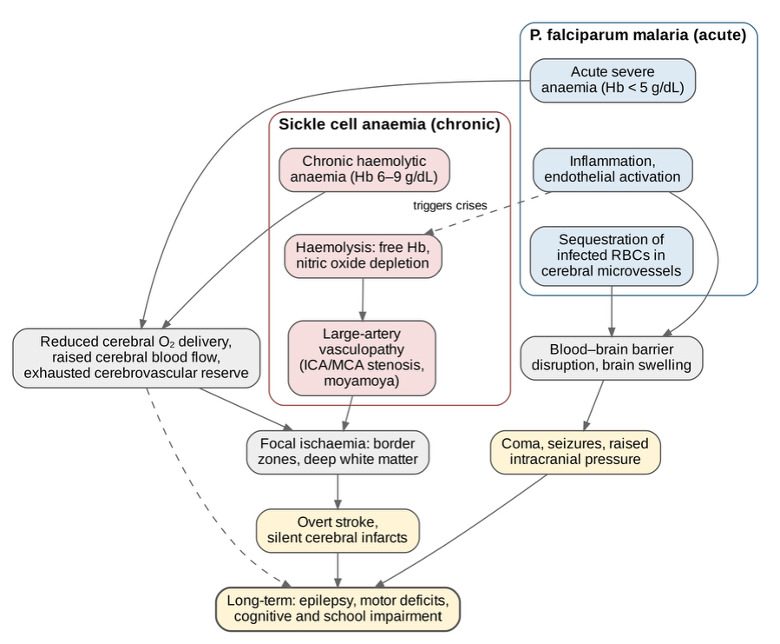
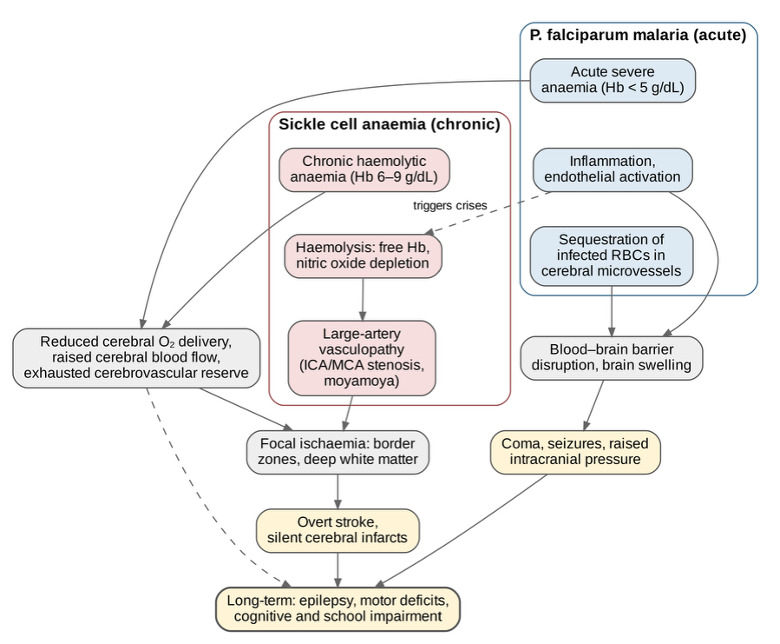
The brain consumes about a fifth of the body’s oxygen and has almost no reserve. Its oxygen supply is the product of cerebral blood flow and arterial oxygen content, which in turn depends on haemoglobin concentration. When haemoglobin falls, the brain compensates by dilating its arterioles and increasing blood flow; in children with SCA, whose haemoglobin is usually between 6 and 9 g/dL, resting cerebral blood flow is chronically raised and the capacity for further dilatation, the cerebrovascular reserve, is largely exhausted. Any additional fall in haemoglobin, fever, hypoxaemia or rise in metabolic demand can then tip vulnerable territories into ischaemia. The deep white matter and the border zones between major arterial territories, which are perfused last and at the lowest pressure, are the first to suffer, explaining the typical distribution of silent cerebral infarcts.5,6
In SCA, three further processes add to anaemia. Intravascular haemolysis releases free haemoglobin, which scavenges nitric oxide and promotes endothelial dysfunction and vasoconstriction. Repeated adhesion of sickled red cells and leucocytes to the endothelium, together with high-velocity turbulent flow, produces intimal hyperplasia of the distal internal carotid and proximal middle and anterior cerebral arteries; in a minority, progressive stenosis leads to moyamoya collaterals. Finally, vaso-occlusion in small vessels contributes to microinfarction. Transcranial Doppler (TCD) ultrasonography captures the combined effect of anaemia and stenosis as raised flow velocity, which is why it predicts stroke.7
In malaria, the dominant mechanisms are different but converge on the same endpoint. In cerebral malaria, parasitised red cells adhere to the endothelium of cerebral microvessels through parasite proteins that bind host receptors, causing sequestration, microvascular obstruction, endothelial activation, breakdown of the blood–brain barrier and, in many children, life-threatening brain swelling.8,9 In severe malarial anaemia, which is often less dramatic at presentation, haemoglobin may fall below 5 g/dL within days through destruction of infected and uninfected red cells and suppression of erythropoiesis, and the brain is exposed to acute hypoxia superimposed on systemic inflammation. Acute kidney injury and metabolic disturbances, which accompany both syndromes, appear to contribute independently to later cognitive deficits.10
Figure 1 summarises how these pathways overlap. The practical consequence is that, in a child with SCA, a malaria episode can simultaneously deepen anaemia, trigger haemolytic and vaso-occlusive crises and add inflammatory endothelial injury to a cerebral circulation that is already operating at its limit.
3. Neurological complications of sickle cell anaemia
3.1. Overt stroke
Ischaemic stroke is the most feared neurological complication of SCA in childhood, with a peak incidence between two and nine years of age. Haemorrhagic stroke is less common and occurs mainly in adolescents and adults. The landmark STOP trial showed that children with time-averaged mean maximum velocities of 200 cm/s or more in the middle cerebral or distal internal carotid artery had a high risk of first stroke, and that regular transfusion reduced that risk by about 90%.7 TCD screening followed by transfusion has since transformed outcomes in high-income countries.
In Africa the burden remains high. A systematic review and meta-analysis of African studies estimated a pooled prevalence of stroke of 4.2% among people with SCA, with conditional and abnormal TCD velocities in 10.6% and 6.1%, respectively; seizures (4.4%) and headache (18.9%) were also common, while silent infarcts, neuropathies and neurocognitive outcomes had barely been studied at the time.11 These figures almost certainly underestimate the true burden, because children who die early, or who have strokes without reaching hospital, are not counted.
3.2. Silent cerebral infarcts
Silent cerebral infarcts are areas of ischaemic injury visible on magnetic resonance imaging (MRI) without a corresponding history of focal neurological deficit. They are the most common neurological lesion in SCA, affecting roughly a third of children in high-income cohorts by adolescence, and they are associated with lower intelligence quotient, poorer school performance and an increased risk of overt stroke. In the Silent Infarct Transfusion (SIT) trial, regular transfusion reduced the recurrence of infarcts in children with existing silent infarcts.5 Guidelines from the American Society of Hematology recommend at least one screening MRI in school-age children with SCA,6 a recommendation that is rarely feasible in LMICs where MRI is scarce and sedation unsafe.
3.3. Cognitive impairment
Cognitive deficits in SCA are not confined to children with infarcts. Chronic anaemia, low oxygen saturation, high cerebral blood flow, social disadvantage and repeated illness and school absence all contribute. In a cross-sectional study of 242 Ugandan children with SCA and 127 unaffected siblings, those with SCA scored significantly lower on overall cognition and executive function, particularly after the age of five, and previous stroke was the strongest clinical predictor of poor cognition.12 Executive function, processing speed and attention are especially affected, with consequences for school progress that accumulate over time.
Encouragingly, cognitive outcomes may be modifiable. In an open-label trial in Uganda, 264 children aged three to nine years treated with hydroxyurea escalated to the maximum tolerated dose showed improvements in cognition, attention and executive function over 18 months, the proportion with cognitive impairment fell from 8.7% to 4.0%, and their scores no longer differed significantly from those of sibling controls; gains were greater in children with higher haemoglobin and lower TCD velocities.13 The absence of a randomised control group and the possibility of practice effects require caution, but the findings support early treatment.
3.4. Other neurological manifestations
Headache, seizures and epilepsy, posterior reversible encephalopathy, cerebral venous thrombosis, spinal cord infarction and peripheral neuropathy have all been described in SCA. Headache is frequent and may be the only symptom of an acute silent infarct, haemorrhage or venous thrombosis. Seizures are several times more common than in the general population and often reflect underlying infarction. In adults, cognitive decline, depression and chronic pain interact and affect employment and quality of life, an area that has received little attention in LMICs.
4. Neurological complications of malaria and malarial anaemia
4.1. Cerebral malaria
Cerebral malaria is defined clinically as unrousable coma in a patient with P. falciparum parasitaemia and no other identifiable cause. In African children, the diagnosis is strengthened by malarial retinopathy, which reflects the same microvascular sequestration that occurs in the brain. Even with parenteral artesunate, case fatality remains around 15–25%.9,14 MRI studies in Malawi showed that severe brain swelling was present in 84% of children who died, compared with 27% of survivors, identifying raised intracranial pressure as the main mechanism of death.8 Seizures, often subtle or non-convulsive, are common and contribute to both mortality and later deficits.
No adjunctive therapy has yet been shown to improve outcome. Corticosteroids, mannitol, anti-tumour necrosis factor antibodies, phenobarbital and several other agents were ineffective or harmful in clinical trials, while approaches such as hypertonic saline for brain swelling, angiopoietin–Tie2 modulation, statins and agents targeting endothelial activation are under investigation.14 Supportive care, including airway protection, correction of hypoglycaemia, careful fluid management, treatment of seizures and timely transfusion, therefore remains the cornerstone of management.
4.2. Neurological sequelae after cerebral malaria
Survivors of cerebral malaria carry a substantial burden of disability. In the Blantyre Malaria Project Epilepsy Study, about one in ten children with retinopathy-confirmed cerebral malaria developed epilepsy, and new neurological deficits and behavioural disorders were frequent compared with unexposed children.15 Motor deficits, speech and language disorders, visual impairment and attention-deficit and disruptive behaviour disorders are well documented, and neurodevelopmental impairment remains common one year after the acute illness.16 The risk is highest in children with prolonged coma, repeated seizures, brain swelling, hypoglycaemia and acute kidney injury.
4.3. Severe malarial anaemia: a neglected cause of brain injury
Severe malarial anaemia, defined by a haemoglobin concentration below 5 g/dL with parasitaemia, is more common than cerebral malaria and has traditionally been regarded as a condition with good neurological outcome once transfusion has been given. That view is no longer tenable. In the Ugandan MIND cohorts, 889 children were assessed four to fifteen years after an episode of severe malaria and compared with community children. Those who had survived cerebral malaria or severe malarial anaemia had lower overall cognitive ability and mathematics achievement, with differences equivalent to approximately 3 to 7 points on an intelligence quotient scale, whereas children with other forms of severe malaria did not differ from controls; acute kidney injury and raised uric acid during the acute episode were associated with worse long-term outcomes.10 Because severe malarial anaemia affects hundreds of thousands of children each year, its contribution to population-level cognitive loss may exceed that of cerebral malaria.
5. Where the two conditions meet
The relationship between SCA and malaria is paradoxical. Sickle trait protects against severe malaria, and in the TRACT trial of Ugandan children admitted with severe anaemia, P. falciparum parasitaemia was found in only a third of children with SCA, compared with more than three-quarters of children without it.4 Children with SCA thus appear to be relatively protected against classic high-density severe malaria, yet even low-density infection can trigger profound haemolysis and anaemic crises that are rapidly fatal without transfusion.4 For the brain, every such crisis is an additional episode of acute hypoxia superimposed on chronic vulnerability.
For two decades, concern that hydroxyurea might increase malaria risk, through effects on fetal haemoglobin, neutrophils or the spleen, delayed its use in Africa. That concern has been answered. In the NOHARM trial in Uganda, hydroxyurea did not increase the incidence of malaria compared with placebo.17 In the multinational REACH study in Angola, the Democratic Republic of the Congo, Kenya and Uganda, open-label hydroxyurea was feasible and safe and was associated with reductions in vaso-occlusive events, infections, malaria, transfusions and death.18 Escalation to the maximum tolerated dose produced greater haematological benefit and fewer clinical complications than a fixed moderate dose, without excess toxicity.19
Malaria chemoprevention is a second pillar. In the CHEMCHA trial in Uganda and Malawi, weekly dihydroartemisinin–piperaquine reduced clinical malaria by 80% compared with monthly sulfadoxine–pyrimethamine, the current standard in many countries, and also reduced malaria hospitalisations and blood transfusions; an excess of respiratory hospitalisations in the dihydroartemisinin–piperaquine arm requires further study.20 In regions with widespread sulfadoxine–pyrimethamine resistance, these results are likely to shape national guidelines.
6. Clinical assessment with limited resources
Most children with neurological complications of SCA or malaria are first seen by nurses, clinical officers or general practitioners in facilities without imaging, electroencephalography or a neurologist. Careful bedside assessment therefore carries much of the diagnostic load. In a febrile child with impaired consciousness in an endemic area, the Blantyre coma scale, a check of blood glucose and haemoglobin, a malaria rapid diagnostic test or blood film, and a search for focal signs, meningism and subtle seizure activity should be routine. Fundoscopy for malarial retinopathy, which can be learnt by non-ophthalmologists with an ordinary ophthalmoscope, helps to distinguish true cerebral malaria from coma with incidental parasitaemia and therefore to search for alternative diagnoses such as bacterial meningitis or encephalitis.9
In a child with known or suspected SCA, any acute focal deficit, new severe headache, seizure or unexplained change in behaviour should be treated as a possible stroke. Where MRI is not available, computed tomography can exclude haemorrhage, but a normal scan in the first hours does not exclude ischaemia; in such cases, urgent simple or exchange transfusion should not be delayed for imaging.6 Children presenting with severe anaemia should be asked about previous transfusions, jaundice, dactylitis and family history, because undiagnosed SCA is common among them, and the opportunity for diagnosis, hydroxyurea and follow-up should not be lost.4
Chronic, less visible damage requires a different approach. Developmental and cognitive impairment rarely leads a family to seek care, and it is usually recognised only when a child repeats school years. Brief developmental screening tools validated in African settings, school reports and simple questions to caregivers about learning, attention and behaviour can be integrated into routine SCA clinic visits and into the follow-up of children discharged after cerebral malaria or severe malarial anaemia.10,12 Seizures after discharge should prompt evaluation for epilepsy rather than assumption of recurrent malaria.15 Where possible, TCD should be offered annually from the age of two years to every child with SCA, and MRI reserved for children with neurological signs, cognitive decline or conditional and abnormal TCD velocities.6
Finally, the neurological consequences of these diseases do not end in childhood or at national borders. Increasing survival means that adolescents and adults with SCA in Africa now live with the cumulative effects of silent infarcts, vasculopathy and chronic pain, while migration has brought SCA and imported malaria into the daily practice of European clinicians, including those in south-eastern Europe. Awareness of the patterns described in this review is therefore relevant well beyond the tropics.
7. Stroke prevention adapted to resource-limited settings
The STOP paradigm of TCD screening followed by indefinite monthly transfusion is not sustainable in most of Africa, where safe blood is scarce, iron chelation unaffordable and the risks of transfusion-transmitted infection and alloimmunisation considerable. Hydroxyurea offers an alternative. The TWiTCH trial showed that, in children with abnormal TCD velocities and no severe vasculopathy who had received at least a year of transfusions, switching to hydroxyurea was non-inferior to continued transfusion for maintaining TCD velocities.21 The American Society of Hematology accordingly recommends, for low- and middle-income settings without access to regular transfusion, hydroxyurea at a dose of at least 20 mg/kg/day for children with abnormal TCD velocities.6
African trials have since tested primary prevention directly. In the SPRING trial in northern Nigeria, 220 children with abnormal TCD velocities were randomised to low-dose (10 mg/kg/day) or moderate-dose (20 mg/kg/day) hydroxyurea; stroke incidence was low in both groups (1.19 and 1.92 per 100 person-years) and did not differ significantly, compared with historical rates of about 10 per 100 person-years without treatment, while all-cause hospitalisation was lower with the moderate dose.22 These data, together with the cognitive findings described above,13 support a strategy in which every child with SCA receives hydroxyurea from infancy, with TCD used where available to identify children who need dose escalation or, where possible, transfusion.
Implementation remains the main obstacle. TCD requires trained operators and equipment that few district hospitals possess; task-shifting to nurses and non-imaging TCD devices, which have been introduced in several African programmes, can extend coverage. Newborn screening, still available only in pilot programmes in most African countries, is the entry point without which neither hydroxyurea nor TCD can be offered early enough.2
8. Preventing brain injury from malarial anaemia
Because the neurological damage of severe malaria occurs largely before or during admission, prevention is the most effective neuroprotective strategy. Insecticide-treated nets, seasonal malaria chemoprevention and prompt testing and treatment at community level remain fundamental. Two malaria vaccines are now recommended by the WHO for children in endemic areas: RTS,S/AS01 and R21/Matrix-M. In a phase 3 trial in four African countries, R21/Matrix-M showed an efficacy against clinical malaria of 75% at seasonal sites and 68% at sites with perennial transmission over 12 months,23 and both vaccines are being introduced across a growing number of African countries.
Children who survive severe anaemia remain at high risk after discharge. In a randomised trial in Kenya and Uganda, post-discharge malaria chemoprevention with monthly artemether–lumefantrine for three months reduced death or readmission over six months by 35%, with the greatest benefit during the period of drug administration.24 The WHO now recommends this approach in areas of moderate to high transmission. Whether preventing recurrent anaemia also protects long-term cognition has not yet been tested, but given the MIND findings10 it is a plausible and important question.
9. Equity, cost and the treatment gap
The contrast between innovation and access is nowhere sharper than in sickle cell disease. Gene-editing therapy with exagamglogene autotemcel eliminated vaso-occlusive crises for at least 12 months in almost all treated patients,25 but at a price of more than two million US dollars per patient and with the need for myeloablative conditioning and specialist transplant facilities it is unlikely to reach the children of sub-Saharan Africa in the foreseeable future. Hydroxyurea, by contrast, costs a few dollars per month, is on the WHO List of Essential Medicines, and has been shown in African trials to be safe, effective and potentially neuroprotective.13,18,19 Its coverage, however, remains low, limited by supply, cost to families, lack of paediatric formulations and the need for laboratory monitoring.2
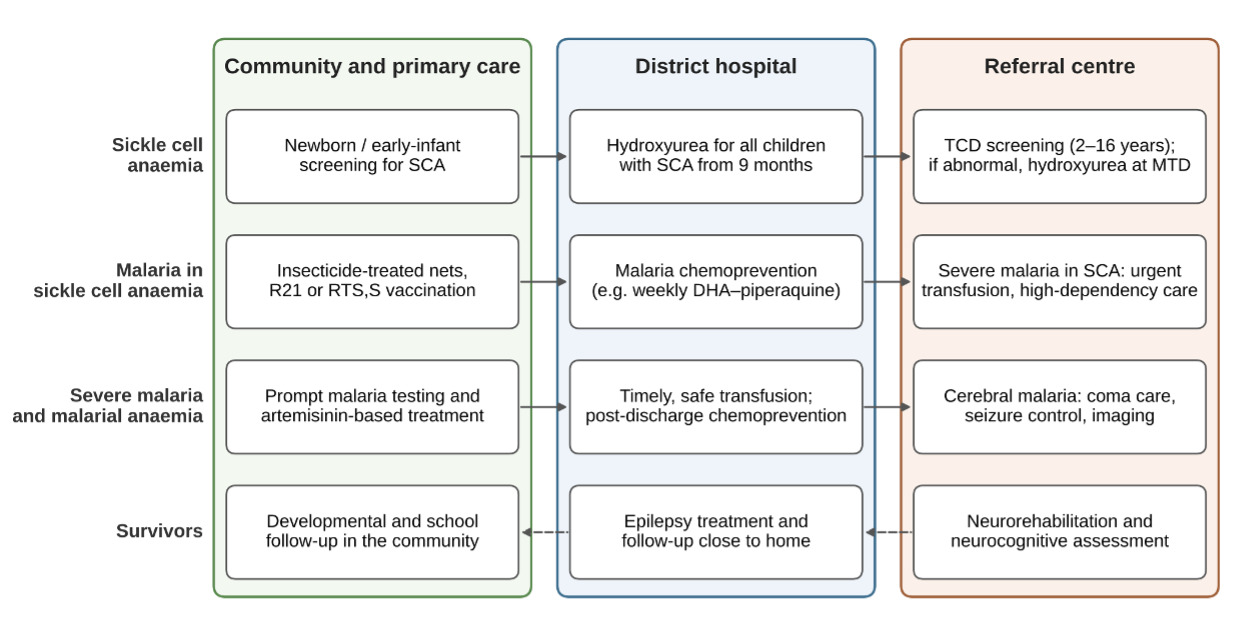
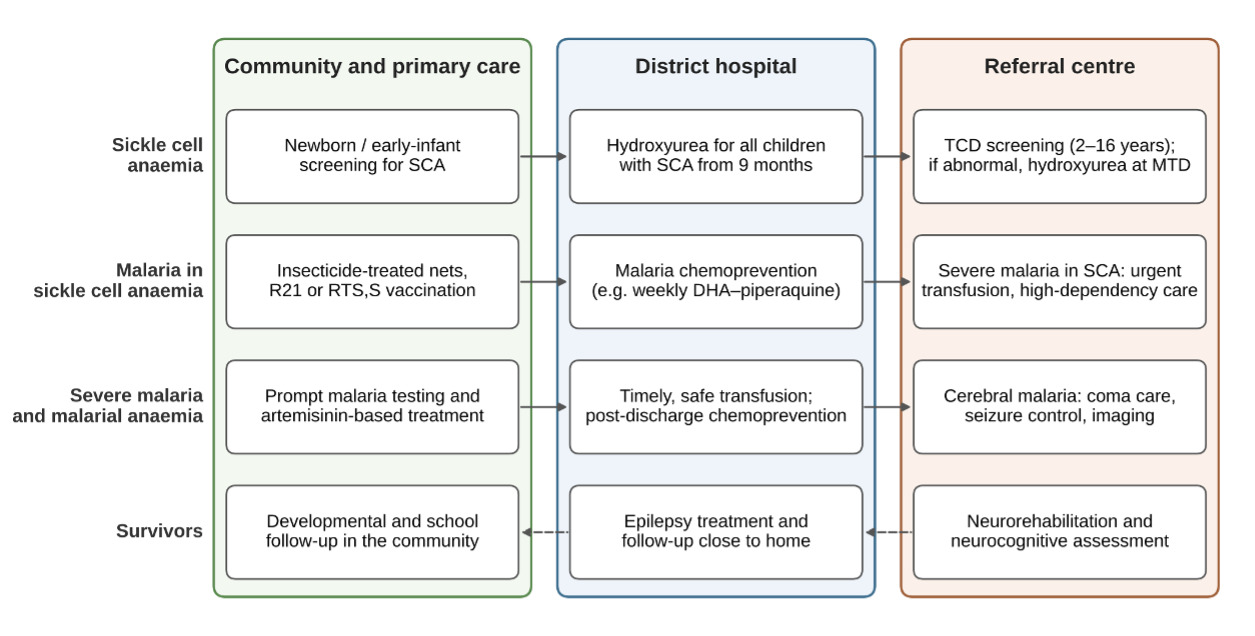
Neurological rehabilitation and long-term follow-up are an even larger gap. Few LMICs have paediatric neurologists, neuropsychologists or rehabilitation services outside capital cities, and children with post-malarial epilepsy or cognitive impairment often go unrecognised until they fail at school. Simple, culturally adapted developmental screening tools, school-based support and access to antiseizure medication would address part of this burden at low cost. Figure 2 presents a tiered model of integrated care in which the same health system levels manage both conditions.
10. Research priorities
Several questions deserve priority. First, the population-level contribution of severe malarial anaemia to cognitive impairment, and whether malaria prevention, vaccination or post-discharge chemoprevention protects cognition, should be studied in prospective cohorts and trials with neurodevelopmental endpoints. Second, randomised data are needed on whether hydroxyurea started in infancy prevents silent infarcts and cognitive decline in African children, and on the optimal dose in malaria-endemic settings. Third, low-cost tools for detecting cerebral vasculopathy and silent infarcts, such as portable low-field MRI and automated TCD, should be validated in LMIC populations. Fourth, adjunctive neuroprotective therapies for cerebral malaria need well-designed trials with long-term neurological outcomes. Finally, the experience of people with SCA who reach adulthood in Africa, including their cognitive, psychiatric and occupational outcomes, is almost entirely undocumented.
11. Conclusions
Sickle cell anaemia and malarial anaemia are two faces of the same problem in many LMICs: a child’s brain deprived of oxygen at the stage of life when it is building the capacities needed for learning and work. Both conditions cause acute catastrophes, such as stroke and coma, and quieter, cumulative injury in the form of silent infarcts and loss of cognitive ability. The evidence of the past decade is encouraging. Affordable interventions, including hydroxyurea, malaria chemoprevention, vaccines and post-discharge care, have been tested in Africa, are safe and reduce complications that damage the brain. The task now is to integrate them into health systems, starting with newborn screening and extending to long-term neurodevelopmental follow-up, so that the neurological consequences of these anaemias are prevented rather than merely described.
Conflict of interest statement
The author declares no conflict of interest.
Funding statement
This work received no specific grant or funding from any public, commercial or not-for-profit funding agency.