
1. Introduction
Gender has been conceptualised as a core social determinant of health within the social determinants of health framework of the World Health Organization (WHO).1 Transgender individuals, the world over, experience stigma and discrimination from family, peers and society due to their gender identity. This has an adverse impact on their mental wellbeing. In the United States of America (USA), nationally representative data shows a higher prevalence of mental disorder diagnoses in transgender hospital patients compared with cisgenders -77% vs 37.8%.2 In India, a study found a significant correlation between exposure to verbal abuse and transgender identity, and further found that discrimination and the environmental domain of quality of life were negatively correlated.3 In the state of Karnataka, India, the suicide rate among transgender individuals was found to be 31%, and 50% of transgender teens and middle-aged transgender adults had attempted suicide at least once.4 A study of 300 transwomen in 4 states of India found that 42.7% of them suffered from moderate/severe depression.5 Another study in India found that 48% of transgender participants suffered from psychiatric disorders, but none of the study participants had ever had psychiatric consultation for these issues.6 This reluctance to seek care is the result of economic and socio-cultural barriers – transgender individuals faced discrimination in health facilities and were even refused care. A study showed that 76.7% of participants reported experiencing discrimination while accessing healthcare service.7 Further, research showed that mental health literacy was low and help-seeking behaviours was poor among transgender individuals.8
Transgender individuals in India are increasingly using smart phones, with social media being an important form of socialization. A systematic review found that social media was a popular tool used by young people who identified as lesbian, gay, bisexual, transgender, and queer (LGBTQ) to connect with their communities.9 It was used to negotiate and explore identity and obtain support from peers on various social media platforms. The review also found that social media usage was associated with reduced mental health concerns and increased wellbeing among them. A study conducted in USA, found that transgender, non-binary and gender diverse youth were more likely to use social media to explore identity; further the study found a positive correlation between the use of social media, positive body image and wellbeing.10 A study showed that transgender and gender diverse adolescents used the social media and the internet to experiment with their gender identity (60%), and coming out (31%), for social transition (88%) and for online support (45%).11 This support includes emotional support through peers and role models, appraisal support for validating their experiences, and informational support for navigating health decisions and educating family and friends.12 An Indian study found that transgender women expressed interest in receiving short health-related videos and text messages that provided information on HIV, mental health and gender transition, and concluded that at risk transgender women could potentially be reached through smartphone based online health promotion interventions.13
In this article we report the findings of a study entitled ProMoting the mentAl health aNd wellbeing of Transgender persons in the national capital region of DelHi: AN intervention using SOCIAL media (Manthan Social), which sought to examine the feasibility and acceptability of using social media to promote the mental health and wellbeing of transgender individuals. We hypothesized that the social media platform created as part of the Manthan Social study would be feasible to implement and acceptable to the transgender study participants.
2. Methods
2.1. Design, Setting and Participants
Manthan Social employed a before-after study design. The participants of the Manthan Social study were transgender individuals living in the National Capital Region of Delhi (Delhi NCR) with mild risk of depression and/or anxiety. People with mild depression/ anxiety have a lower level of symptom severity (when compared to people with moderate/severe risk), which can be further reduced with low-intensity, self-administered support as the first line of treatment, rather than psychotherapy or medication. Hence, in the Manthan Social study, the research team decided to administer an intervention which was low-intensity, self-directed and could be implemented with limited resources, to transgender individuals with mild risk of depression and/or anxiety.
A total of 300 consenting transgender individuals were screened for depression and anxiety using the Patient Health Questionnaire-9 Items (PHQ-9)14 and the Generalized Anxiety Disorder Scale–7 Items (GAD-7)15 between July – August 2024, as part of a larger study entitled Manthan.16 The larger Manthan study aimed to study the acceptability, feasibility and preliminary efficacy of an in-person peer support approach in promoting the mental health and wellbeing of transgender individuals in Delhi NCR who were at moderate or severe risk of depression and/or anxiety. During this screening process, it was found that 46 transgender individuals, met the eligibility criteria (Table 1) for the Manthan Social study. Of the 46 transgender individuals, 31 consented and were included in the study.
2.2. Intervention and Implementation
The core component of the intervention was the Manthan social media platform that drew upon elements of the peer support model created for the larger Manthan study. The Manthan social media platform comprised of an Instagram page and a WhatsApp group. The Manthan Instagram page was a public account i.e. it could be accessed by anyone, while the WhatsApp group was a closed group which could only be accessed by the study participants. Study participants who had an Instagram account, were invited to follow the Manthan Instagram account. A link was sent to the closed WhatsApp group that enabled participants who did not have an Instagram account to access the Manthan Instagram page.
Over a nine-month intervention period, the researchers posted 20 posts that focused on giving information on depression and anxiety and how to deal with them, understanding emotions, stress, burnout, anger management, suicide ideation, the importance of self-care and help- seeking. Besides these, one post was in response to current events, while two other posts were in response to requests of the transgender participants. The research team experimented with different post formats, to enable them to understand what appealed to participants and drove engagement on Instagram.
The research team also experimented with collaborative and non-collaborative posts. Collaborative posts (also known as Collabs)17 is a feature on Instagram which allows the holder of an account to invite up to five other account holders to share the post (of the inviter) with the followers of the invitees; while non-collaborative posts are “regular” Instagram posts in which no account has been invited to share the post with their followers. Of the 20 posts on the Manthan Instagram page, three were collaborative in nature and 17 were non-collaborative. All three collaborations were with people from the LGBTIQ community.
2.3. Data collection
A baseline survey was administered telephonically to the study participants to capture socio-demographic details, information related to social media usage, and to capture wellbeing using the World Health Organization Wellbeing Index-5 Item scale (WHO-5),18 knowledge, attitude and behavior related to mental health using the Mental Health Knowledge, Attitude and Behavior scale (KAB).19
Quantitative data was collected on the level of interaction with the Manthan Instagram page. Data was collected on the number of views that a post got as well as the percentage of these views by people who followed the Manthan Social Instagram page.
Qualitative data was collected from 28 participants as part of the endline; in-depth interviews were held telephonically. The interview transcripts were translated into English and were coded manually by the research team. The interviews explored participants’ views on the usefulness of the content and suggestions on how to improve them. For participants who did not view any of the content, the reasons for not viewing were explored.
Outcome data was also collected telephonically at the endline, during which, the PHQ-9, GAD-7, WHO-5 and KAB were re-administered to the study participants.
2.4. Study Outcomes
Quantitative data related to interactions with the content of the Manthan Instagram page and withdrawal/non-response rates were analyzed to understand engagement with the platform; this is indicative of the acceptability of the Manthan social media platform. Interaction included ‘likes’, ‘comments’, ‘shares’ and ‘saves’, in response to a post.20 The engagement rate of a post revealed the relationship between the number of followers of the account and the interaction that a post received; it was calculated by the following formula:21
Engagement Rate =Average number of interactions per postNumber of followers of the Instagram account×100
Baseline characteristics were summarized using counts and percentages for categorical variables and mean and standard deviation for numeric variables. Differences in PHQ-9, GAD-7, WHO-5 and KAB scores at pre and post intervention were tested using paired t-test. Mean difference in scores along with its 95% confidence interval and p-value were presented.
2.5. Ethical considerations
The study was approved by the George Institute Ethics Committee, New Delhi, India. All data management processes were compliant with national privacy law. Data were securely stored and analyzed on servers located at the George Institute India office.
3. Results
3.1. Baseline characteristics of study participants
Nineteen of the 31 participants identified as being transgender women (61%) and 12 (39%) identified as being transgender men (Table 3). None of the participants were non-literate; and most of them (61.3%) had either completed graduation or were currently pursuing their graduation. Most of the participants (48.4%) were working in the private sector or in civil society organizations (32.3%). Around 13% were unemployed and approximately 3% each were engaged in the traditional occupation of Hijra gharanas, sex work and other occupations.
3.2. Social media engagement
The Manthan Social intervention was rolled out between 21st December 2024 to 21st September 2025. WhatsApp and Instagram were the most popular social media platforms with all study participants on WhatsApp and 96.8% on Instagram (Table 3). Time spent on social media varied among the study participants with 35.5% spending between three to five hours, 32.3% spending one to two hours and 22.6% spending more than five hours a day on social media.
Data related to engagement with the Manthan Instagram page was extracted at the end of the intervention. Details are presented in Table 4 which includes engagement information of the study participants as well as of non-study individuals who had engaged with the Manthan Instagram page.
Collaborative post:
There were three collaborative posts which garnered an average of 750 views, reached an average of 525 accounts, had an average of 48 interactions and gained an average of three followers per post.
Non-collaborative post:
There were 17 non-collaborative posts; 15 of them were in video format and two were in an image/pictorial format. The posts had an average of 152 views, reached an average of 113 accounts and had an average of 4 interactions. Only one follower was gained in total across the 17 posts. The average engagement rate was 5 %. Posts which used a video format averaged 5 interactions while posts that used picture formats averaged 2 interactions. Live action video posts got a higher interaction (average 5) than those not featuring a person (average 3).
3.3. Interaction of study participants with the Manthan Instagram posts
At endline, data was collected from 28 of the 31 participants. Fourteen participants (50%) had viewed at least one of the posts. Of the 28 participants, 17.9% had viewed all 20 posts, another 14.3% had viewed between 6 to 10 posts and 17.9% had viewed between 1 to 5 posts. Of the participants who viewed the posts (n=14), 28.6% engaged with them. Those who had viewed or engaged with the Manthan Instagram page strongly felt that social media was a powerful platform that could be used to promote mental health awareness.
“Social media is one of the biggest platforms (for outreach), despite being busy people find the time to look up things on social media” (Transgender man)
Another participant added that one of the greatest positives of social media is the anonymity that it gives - a person does not need to reveal their identity yet can share their problems without fear.
Nearly 42% of participants who had viewed the posts found them to be useful. Participants mentioned that the posts related to stress management and self-care were especially useful with one participant stating that they had saved it for future use. The post related to marriage and legal aspects was found to be important and informative.
Participants stated that they liked the colors used, the font size and the use of conversational language in the posts. Participants also gave suggestions on how the videos could be made more engaging, creative and relatable. One participant recommended posting videos that depict people demonstrating the skills (grounding exercises, breathing exercises, meditation) that the posts talked about to promote better understanding. Another participant felt that the posts should be exciting:
"You need to add some spice to the visuals, even if it’s (post) about mental health (serious issue), you still need a bit of spice; only then as an audience member I’ll enjoy it and feel like I can relate to it. If I’m going through mental health issues, like anxiety then I’ll try to relate. But if I’m not going through it and your video comes, I won’t feel any connection" (Transgender man)
Participants gave suggestions on additional topics that should be covered such as increasing awareness-based content and felt that posts that address fear and stigma surrounding mental illness were needed. They also suggested that it was important to create posts that provide practical tips for people with mental illness.
“There should be more content for awareness – like reducing phobia and what precautions people with mental health conditions can take.” (Transgender woman)
Speaking about the nature of Instagram, a participant mentioned that they followed the videos that connected with them, however the impression that it left was short-lived, as after a while, they would begin to watch something else and would forget about the earlier post.
“We watch the video and follow it too, but after some time, we see something else and then our mind begins to wander.” (Transgender woman)
One of the ways to tackle this short attention span, according to a study participant, was to combine online content with offline engagement. In-person direct contact, they felt would leave a lasting impression and be more effective than watching online videos only. Another participant suggested that it would be good if there was a mental health professional attached to the social media group so that participants could seek help when needed.
Seventeen of the 31 participants had not engaged with the Manthan Instagram page even once. Fourteen of these 17 participants were telephonically interviewed to explore the reasons behind non-engagement. The interviews revealed that four participants had not accessed Instagram during the entire study duration although they had accounts. Nine mentioned that while they had accessed their Instagram account for short durations, they were too busy and did not find the time to engage with the Manthan Instagram page, and one participant was unable to follow back the Manthan page after their phone had reset.
3.4. Changes in secondary and exploratory outcome measures of study participants (these include even those who had not accessed the Manthan Instagram page)
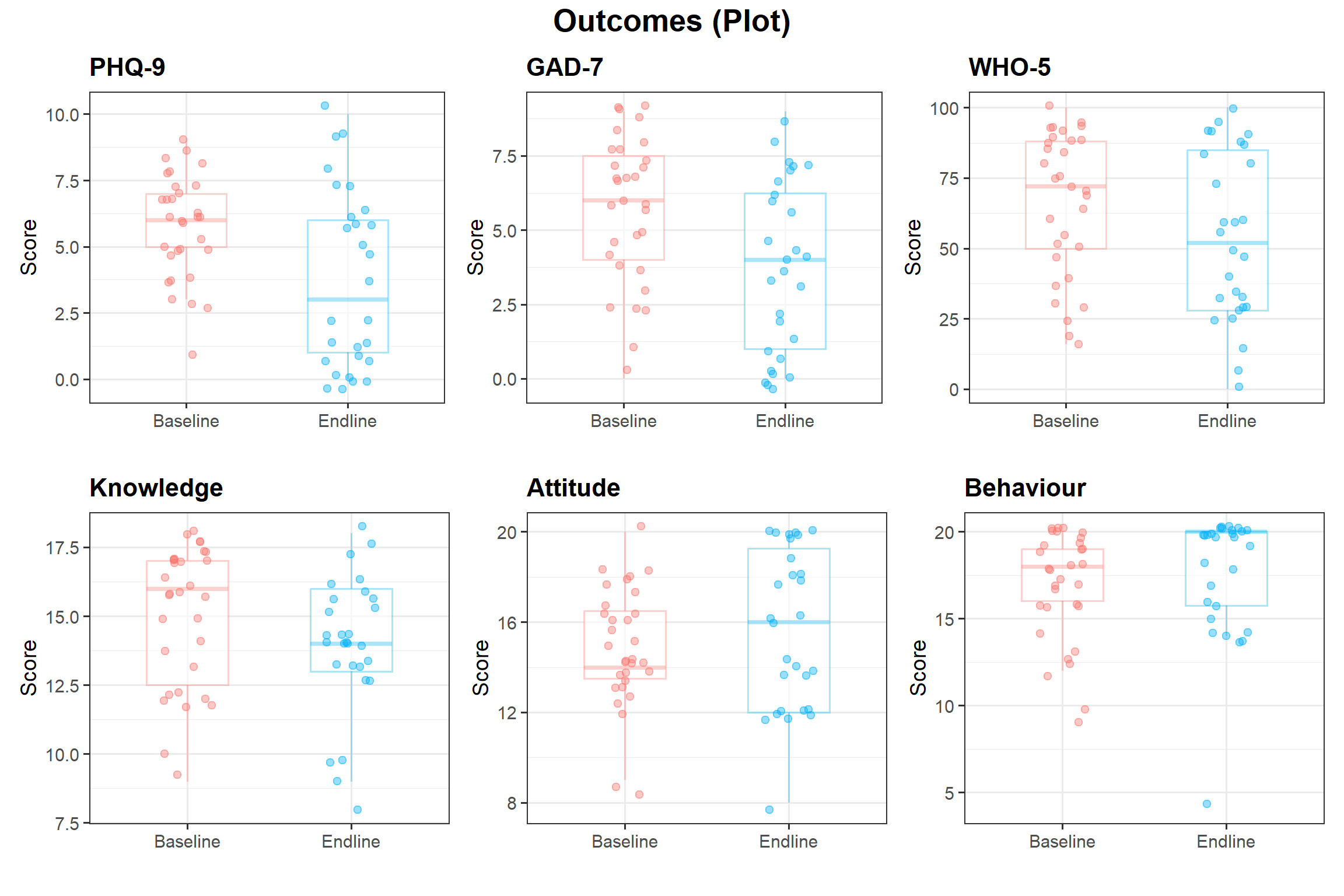
There were statistical differences between pre and post intervention measures of PHQ-9 and GAD-7. Mean PHQ-9 score decreased from 5.68 to 3.71, mean GAD-7 score changed from 5.46 to 3.71. A fourteen unit drop in the mean WHO-5 well-being score and 1.25 unit drop in the mean knowledge score were observed at endline. A small increase in attitude and behaviour was seen from baseline to endline (Figure 1 and Table 5).
_and_endline_(n_28).png)
4. Discussion and Limitations
The results of the Manthan Social study show that the views and interactions that a post received differed significantly based on the type of post. Posts in video formats performed better than pictorial posts. Videos that featured a person fared better than animated videos. This is in line with earlier research which found that videos had greater engagement rates, followed by images of people; the least views and interactions were received for images without people in it.22 Posts that dealt with topical issues such as a post on maintaining mental wellbeing during the 2025 India-Pakistan military activities, received a high view and interaction rate despite being a non-collaborative post. The results also show that collaborative posts received the largest number of views and engagements. The researchers did not consider collaborative posts while calculating engagement rate, as all three collaborating accounts had many followers which would give skewed results.
The overall average engagement rate for non-collaborative posts on the Manthan Instagram page was found to be 5.4%, which is considered to be high for accounts with 0-1000 followers23 (the Manthan Instagram page had 81 followers at end of the intervention). However, the collaborative posts resulted in high outreach beyond the followers of the Manthan Instagram page. These collaborative posts brought in an average of three new followers per post. On the other hand, the non-collaborative posts were able to attract just one new follower over 17 posts. Thus, collaboration with relevant Instagram handles that command a high interaction rate can be very important to boost engagement. This is consistent with earlier research which shows that collaboration of influencers with renowned brands is beneficial; with positive associations that the consumer has towards the influencer and the renowned brand mutually reinforcing each other.24
The findings showed that 45.2% of the total study participants (31) viewed at least one post out of their own voluntary interest. This potentially indicates that social media can be used as a low intensity intervention to disseminate mental health information.
The findings also suggest that there was a significant reduction in depression and anxiety symptoms of the study participants from baseline to endline, however there was a reduction in wellbeing also, over the study period. Despite this reduction in the wellbeing scores from baseline, the scores at endline were higher than 49% which is the suggested cut-off for poor mental wellbeing and is an indication that further assessment for a possible mental health condition is required.18
Further, it was found that while the attitude and behavior scores showed a modest increase from baseline to endline, the knowledge scores decreased which contradicts our findings from earlier studies where knowledge had improved along with attitude and behavior, although this study was conducted in a completely different population.25 The decrease could be because none of the posts specifically addressed the domains of knowledge, attitude and behavior related to mental health stigma. This is an area that should be addressed in subsequent research. The researchers note that the decrease warrants further exploration especially given that the intervention used Instagram only. Changes in knowledge have been explored and reported in the findings related to the larger Manthan study.
The interaction rate for the posts was found to be high; however, the interaction rate could not be calculated with high fidelity as it was done retrospectively and the account’s follower count changed over time distorting the rate. The study also did not devise a method to get feedback from followers of Manthan’s Instagram page, who were not part of the study.
5. Conclusion
Manthan Social was a feasible and acceptable approach for promoting mental health among transgender individuals in Delhi NCR. Collaborative, video-based, and people-centred posts generated greater engagement, indicating the importance of format and delivery in digital mental health interventions. While findings suggest potential for social media as a low-intensity outreach tool, future interventions should explore more targeted and interactive approaches, including integration with offline human support, to strengthen and sustain impact.
Author Contributions
The paper was conceptualised by SKY in discussion with all authors. The data analysis was done by AR and SD. KSB wrote the original draft, which was reviewed and edited by SKY, MKB, NAK. PKM provided critical inputs. All authors commented on previous versions of the manuscript and approved the final manuscript.
Funding
This was a non-funded study.
Conflict of Interests Declaration
There are no sources of funding to declare. However, the authors’ time was supported by various projects. NAK is fully and SKY is partially supported by Adolescent Resilience-Building In Urban Slums - A Multifaceted Implementation Trial Of Life Skills Education In India (ANUMATI 2.0) funded by NHMRC (NHMRC/GACD Grant - 2022355). MKB is fully supported by the Indian Council of Medical Research – ICMR (Grant EMTR/SG-DL/2023/07-3). PKM is a partially supported through DBT/Wellcome Trust India Alliance Senior Fellowship (IA/CPHS/21/1/505968, A randomized controlled trial to evaluate a technology-enabled platform to manage depression with or without behavioural activation in patients with cancer in India, and ANUMATI 2.0. PKM is the CoPI for ANUMATI 2.0 and CoPI on India Alliance-Clinical/Public Health Research Center Grant (IA/TSG/20/1/600061)- Scaling-up The COmpetency of Primary Care Workers to Manage Epilepsy by Task-Sharin(STOP-Epilepsy) study.
Ethics Declaration
All procedures performed in studies involving human participants were in accordance with the ethical standards of The George Institute for Global Health, New Delhi, India (Ref. no.23/2023). The study is in line with the 1964 Helsinki Declaration and its later amendments.
Acknowledgements
We acknowledge, the contribution of the study participants who have generously contributed their time and engaged with the Manthan Social Platform.
Consent
Written Informed Consent has been obtained from all study participants
Data Sharing statement
Relevant anonymized data, metadata and the study protocol are available with the corresponding author and can be shared on receiving a request from anyone for research purposes, as part of a data-sharing agreement, once this paper is published.